
May 23, 2012
May 23, 2012
November 30, 2009
It is time to drag out the anti-war poetry.
War is Kind
by Stephen Crane (1871-1900)
Do not weep, maiden, for war is kind.
Because your lover threw wild hands toward the sky
And affrighted steed ran on alone,
Do not weep
War is kind.
Horse, booming drums of the regiment,
Little souls who thirst for fight,
These men were born to drill and die.
The unexplained glory flies above them,
Great is the battle god, great, and his kingdom
A field where a thousand corpses lie.
Do not weep, babe, for war is kind.
Because your father tumbled in the yellow trenches,
Raged at his breast, gulped and died,
Do not weep.
War is kind.
Swift blazing flag of the regiment,
Eagle with crest of red and gold,
These men were born to drill and die.
Point for them the virtue of slaughter,
Make plain to them the excellence of killing
And a field where a thousand corpses lie.
Mother whose hear hung humble as a button
On the bright splendid shroud of your son,
Do not weep,
War is kind.
Dulce Et Decorum Est
Wilfred Owen (1893-1918)
Bent double, like old beggars under
sacks,
Knock-kneed, coughing like hags, we cursed through sludge,
Till on the haunting flares we turned our backs
And toward our distant rest began to trudge.
Men marched asleep. Many had lost their boots
But limped on, blood-shod. All went lame; all blind;
Drunk with fatigue; deaf even to the hoots
Of tired, outstripped Five-Nines that dropped behind.
Gas! Gas! Quick boys!–An ecstasy of fumbling,
Fitting the clumsy helmets just in time;
But someone still was yelling out and stumbling
And flound’ring like a man in fire or lime…
Dim, through the misty panes and thick green light,
As under a green sea, I saw him drowning.
In all my dreams, before my helpless sight,
He plunges at me, guttering, choking, drowning.
If in some smothering dreams you too could pace
Behind the wagon that we flung him in,
And watch the white eyes writing in his face,
His hanging face, like a devil’s sick of sin;
If you could hear, at every jolt, the blood
Come gargling from the froth-corrupted lungs,
Obscene as cancer, bitter as the cud
Of vile, incurable sores on innocent tongues,–
My friend, you would not tell with such high zest
To children ardent for some desperate glory,
The old Lie: Ducle et decorum est
Pro patria mori.
Its time to know what we’re asking. And I’m not sure that we know. I’m not sure its okay to send men off to die when we don’t know who the enemy is anymore. Or maybe when we’re just out-gunned with evil. Who sets a trap designed to slaughter those going to the aid of the wounded? Not anyone I’d want to die for. Not anyone I’d want to defend.
October 30, 2009

Sir Thomas Wyatt (1503-1542)
They flee from me that Sometime did me Seek
I have seen them gentle, tame, and meek,
That now are wild and do not remember
To take bread at my hand; and now they range,
Busily seeking with a continual change.
Thanked be fortune it hath been otherwise
When her loose gown from her shoulders did fall,
Therewithall sweetly did me kiss
Into a strange fashion of forsaking;
I would fain know what she hath deserved.
I just came across this poem on my new favorite website. The language/culture/history barriers aside, I think, at first reading it is at least interesting. More interesting with this sexier picture of Sir Thomas. Really, wikipedia and Representative Poetry online, you make it hard to love a man! And, btw, he was over 6′ tall, if that helps.
The comentary by Ian Lancashire is very helpful. But I am still a bit scandalized. I mean, look at the date up there! The man was alive in a time that conjures up some very strong imagery for me. But none of it includes a culture of diverse sexual affairs. Which is very niave of me, I know. I realize that for the species to survive, people were having sex. I just never imagined that they were…writing about it. Even if, very subtly writing about it. Was this the type of poetry people talked about in polite company? I’m dying to know. And how was it that this kind of adultery was so widely accepted that poetry like this survived? And who was this woman, in the 1500s that was taking on a man who “lay broad waking” without any agenda aside from… recreation? Ian Lancashire tells us that this type of poetry is very rare. (I should think so!)
“Courtiers, like Henry, wrote love lyrics in pursuing a woman’s sexual favours, but once seduced, unmarried women lost their power. Few men would complain, in lyrics, about being rejected by someone they had successfully bedded because they usually were fully prepared to move on to new sexual partners…”
So, what catagory of litterature is this? Was it the 1500s version of Cosmo? Its so very subtle, I have no idea if this is something people would giggle about in intimate company or if this would have been in the restricted (through time) to only men?
As for the mystery bird, that wild unfettered creature… I’ll tell you what she deserved, Sir Thomas, she deserved some fragment of history to have preserved what it was like for a 16th century woman in the Court of Henry the VIII! Because apparantly, there really is nothing new under the sun. I find it facinating to find how people have always slipped into the margins of history. The things we know about Sir Thomas Wyatt are dry and boring speculation inside dates and facts. Judging by his poetry, he seems like a very complex and sensative character. I am fascinated.
October 26, 2009
Gangotri (The place where The Ganges flows to earth from heaven)
Posted by jessicarrot under writingLeave a Comment

In the thin air at Gangotri, I hover like a ghost.
Every breath is poison.
I fall through a sky of fire
and fade from view.
You hover over me like a halo of mercy.
Palaces, and legacies of
civilizations pass through my eyes
to yours.
Together we purify these bones.
Together we burn and scrape them clean.
And when the stars align,
we shine.
October 13, 2009
DO NOT GO GENTLE INTO THAT GOOD NIGHT
Do not go gentle into that good night,
Old age should burn and rave at close of day;
Rage, rage against the dying of the light.Though wise men at their end know dark is right,
Because their words had forked no lightning they
Do not go gentle into that good night.Good men, the last wave by, crying how bright
Their frail deeds might have danced in a green bay,
Rage, rage against the dying of the light.Wild men who caught and sang the sun in flight,
And learn, too late, they grieved it on its way,
Do not go gentle into that good night.Grave men, near death, who see with blinding sight
Blind eyes could blaze like meteors and be gay,
Rage, rage against the dying of the light.And you, my father, there on the sad height,
Curse, bless me now with your fierce tears, I pray.
Do not go gentle into that good night.
Rage, rage against the dying of the light.Dylan Thomas
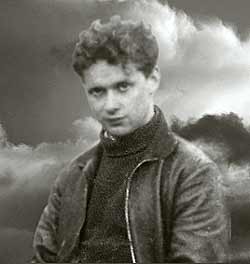
The first time I read those words, it was like they were emblazoned on the shield of the absolute warrior-hero of my dreams. Anyone who could put rage and gentle together in a lyrical poem to his dying father was a ROCK STAR in my book. Imagine my heartache when my 12th grade English teacher snidely remarked that this man, the one who so earnestly plead with his dying father to fight and rage against death walked into the White horse tavern on November 9th 1953 and drank himself to death. It wasn’t enough to stop me from adoring this poem, but I was so utterly disappointed that the rock star went out that way. That he just gave up.
Poetry is important to me at the moment, so I’m revisiting all the masterpieces of my youth. I decided to look up my old flame and a quick Google search may have restored my admiration of the rock star who was Dylan Thomas. What if he didn’t drink himself to death? What if he was sick before he went in to the bar? I am so bored of celebrity who-done-it access Hollywood exclusives about the doctors responsible for killing off celebrities. Yeah, doctors screw up, they are human. When they screw up with someone famous, we all get to hear about it. But according to author David Thomas the personal physician of Dylan Thomas likely misdiagnosed a bronchial infection and proceeded to administer the worst possible drug, morphine, assuming that Dylan Thomas’ condition was the result of his heavy drinking.
People have to take responsibility for their actions, I was appalled at this BBC article that lays blame for DT’s alcoholism at universities for not giving him a fellowship, or at the BBC for not giving him a job as a reporter, or on his reliance on American lecture circuits that kept him away from his wife and family. Nope, I don’t buy the whole celebrity=victim thing. Dylan Thomas was most likely an alchoholic, he had only himself to blame for that. And his poor diet, heavy drinking and sleeplessness contributed to his poor health. But I do take comfort in the new evidence. I guess it isn’t that new, 5 year old evidence that the poet of my dreams did not lay his life down in a fit of drunkenness in a bar. He arrived in New York feeling ill, cheated on his wife with the assistant of his agent and had some drinks. After complaining to his physician that he couldn’t breath, his doctor gave him some morphine, which had the affect of further hampering his breathing. He then colapsed and was admitted to the hospital where he lay comatose until his death. His genius brain was deprived of oxagen and he died of swelling to the brain.
I feel assured that he lived, he strained against his poverty, he met his obligations (if not to his wife) with all the rage he could muster, he used up his life until it he intersected with a fatal series of mistakes, and learning too late, I think he must have grieved on his way to the dying of the light.
I guess it is strange to take comfort in that. But I do.
October 8, 2009








 Jessicarrot